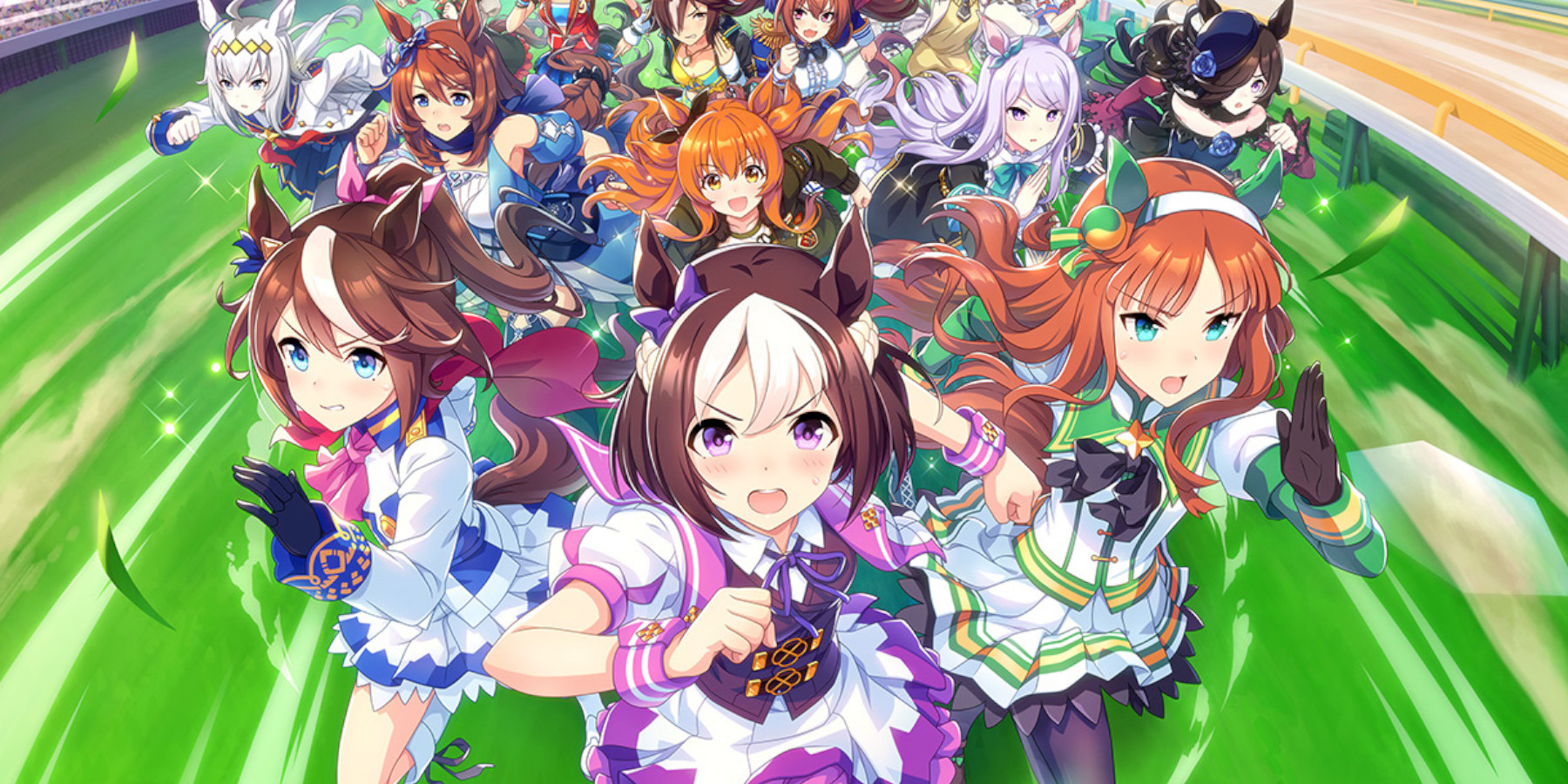
Like most of the internet, I’ve spent the last few weeks obsessed with Umamusume: Pretty Derby, the horse training simulator game where you take famous race horses from across history (who have all been turned into anime girls, naturally) and race them against one another, aiming to carry your chosen pony from the minor leagues to the top trophy. However, the game has left me with several lingering questions, most notably, how do you discuss a game that you both adore and despise?
Let’s get the obvious out of the way first. On a purely technical level, Umamusume is great. The character designs are fun and varied (no easy feat considering all the girls have to map onto the same basic horse-girl body shape), and the animation during the race segments is really well done. The visual novel segments are equally well done, featuring some engrossing writing, surprisingly nuanced character work, and memorable voice acting.
What Is Umamusume (And Why Did I Want To Love It)?

Umamusume’s core single-player gameplay is also pretty fun. The game is divided into turns, each with two parts. At the start of each turn, you choose one thing for your horse girl to do, be it training one of her stats, resting, performing a recreational activity, getting medical treatment, or partaking in an extra race.
However, you have to be careful, as your girl has a stamina meter. The lower this meter, the more likely it is she screws up while training, which can lead to mood drops and the acquisition of various debuffs. Because of this, the game is all about managing time and risk, trying to get as much training in as possible without pushing your girl so hard that she breaks.
The second part of each turn is a short visual novel sequence. Some of these sequences link to your chosen horse girl’s core story, while others are triggered at random based on your chosen support cards. The choices you make during these sequences can affect your girl’s training in numerous ways, from refilling or draining her stamina to giving her points that can be used to buy special abilities.
Then, every so many turns, your horse girl has to compete in a race. During races, the player doesn’t control their horse girl. Instead, the player watches as the game uses her stats to simulate how the whole thing plays out. If your girl finishes in a high enough position, you get to continue the career. If she doesn’t reach the aforementioned minimum position, your game is over, and you have to go right back to the start.
It’s hard to understate how much I love this gameplay loop. I’m a massive fan of management games, and I adore visual novels, meaning that any fusion of the two is bound to catch my eye. In fact, the reason I downloaded Umamusume in the first place was because its description reminded me of two of my favorite games ever: Black Closet and Qvadriga.
Qvadriga is a turn-based racing game where the player manages a team of Roman chariot drivers as they attempt to become the best team of their era. A task that requires careful management of both your drivers and your chariots and horses.
Black Closet is a hybrid visual novel and management game where the player takes control of the student council at a fancy private school. Using their new minions, the player has to solve various issues around the school, all while trying to deduce which member of the council is planning to betray them.
So, Umamusume felt like it was easily going to cement itself as my favorite game ever.
Umamusume Is Riddled With Gacha Tropes

However, my desire to love Umamusume hit several hurdles the second it left the gate. The first is the mere fact that Umamusume is a modern gacha game designed for mobile devices. Because of this, it features the genre’s now-trademark problem: terrible UI.
The game’s main menu epitomises this problem in a way that borders on parody. The top of the screen features two different energy types and two separate in-game currencies. The sides of the screen are littered with buttons, including a massive banner promoting the game’s latest short-term event. Finally, five buttons sit at the bottom of the screen. These buttons take you to other menus, each featuring more buttons that open even more menus.
Overall, the main menu, the first screen you see when starting up the game, features a ludicrous 21 buttons (24 if you include the little speech bubbles that trigger snippets of dialogue from the various horse girls that populate the menu). Even worse, a good number of these buttons, scroll, sparkle, or feature pulsating exclamation marks, meaning the entire screen is a sensory overload.
So, while the horsegirl in the centre of the screen is cute and well-animated, you’ll struggle to look at her for more than a second without your eye being dragged elsewhere.

This is also true of the rest of the game. While the menus in the single-player career mode are intuitive, the rest of the game is a dizzying storm of pop-ups, flashy animations, and sub-menus, meaning that every task takes several more clicks than you think it will, making the experience feel painfully slow.
Plus, like many similar titles, the game’s progression system is needlessly complicated. Whenever you complete a task, you’ll be presented with a pop-up showing all the numerous random items you’ve earned. Naturally, you’ll go into the various menus to work out what these items do, only to be met by a massively complex and painful, unintuitive upgrade system that requires you to have massive amounts of these various items, meaning that if you don’t spend ages painstakingly working out what you need to do, you’ll quickly hit a wall and be forced to embrark on a long and teidious grind.
On top of this, like most games in the genre, Umamusume is riddled with FOMO. The events screen loudly tells you that you only have a few days left to complete its objectives, and the gacha screen always features a countdown of one form or another. This, combined with the needlessly complex UI, means you’re constantly having purchase options dangled in front of you, something that considerably undercuts the game’s charm.
However, the biggest issue with Umamusume is that the gacha genre is inherently untrustworthy.
The Gacha Industry And The Undermining Of Player Trust

This isn’t my first Free-To-Play gacha rodeo. Deep down, we all know that the main aim of all free-to-play gacha games is to get you to head to the store and open your wallet. And that, at the core of every gacha game, sits a throbbing mass of dark patterns that aim to funnel you towards the shiny “buy now” buttons.
Thus, it’s hard to feel like my choices really matter or get invested in the outcomes of races because there is always that lingering bit of doubt in the back of my mind.
Did I lose because I didn’t train the correct stats? Or did I randomly come 18th in this race because the game wants me to lose my patience, head to the store, and buy a couple of gacha pulls to better my chances?
On the contrary, did my horse, who was only the 8th favorite, come first in this race because my expertly planned training regimen allowed them to pull off a fairytale upset win, or did the game throw me a victory because the devs’ stats suggest I’ll stop playing if I lose so many times in a row?
The issue with the proliferation of free-to-play gacha titles is that once you’ve played one, you quickly become aware of all the ways the game is trying to push you towards paying. And, once you notice them, it becomes hard to trust any other game using that set of mechanics, because as you play, you’re always aware that a team of people sat down and pondered the best way to get you to part with money, be it through mechanical walls (such as unfair RNG or tedious grind) or psychological trickery (getting players frustrated before showing them purchase pop-ups).
Because of this, playing Umamusume often feels like playing poker with a player who always cheats. No matter how fun the first few hands are and no matter how frequently they promise they’ll play fair this time, you’re always aware that the rug will eventually be pulled out from under you, making the entire evening feel utterly futile.
What makes this distrust especially painful is that it imbues the visual novel sections with an icky undertone. While having the horsegirl talk directly to the camera (rather than to a model representing the player character) does make sense in a visual novel, having her look directly at me as she explains how crushed and upset she’ll be if she is unable to achieve her dream of winning the big race feels like a deliberate attempt to prey on people prone to parasocial attachment, especially because these scenes are often bookended by loading screens that remind me that better support cards are only a few gacha pulls away.
In an alternative universe, Umamusume: Pretty Derby was released as a regular full-price game without the manipulative gacha underpinnings. In that universe, I’m gushing about the game to all of my friends, telling them how happy I am that someone made my dream game a reality. However, in this universe, Umamusume leaves me in a quandary. While the characters and core gameplay are enjoyable, they are trapped beneath a suffocating blanket of tired gacha mechanics designed to exploit the vulnerable and please investors rather than deliver a good gameplay experience. This means that, despite loving many of the game’s individual elements, I can’t fully enjoy it or recommend it to others with a clean conscience.
So, I guess in that way, Umamusume is the perfect simulation of the horse racing industry…