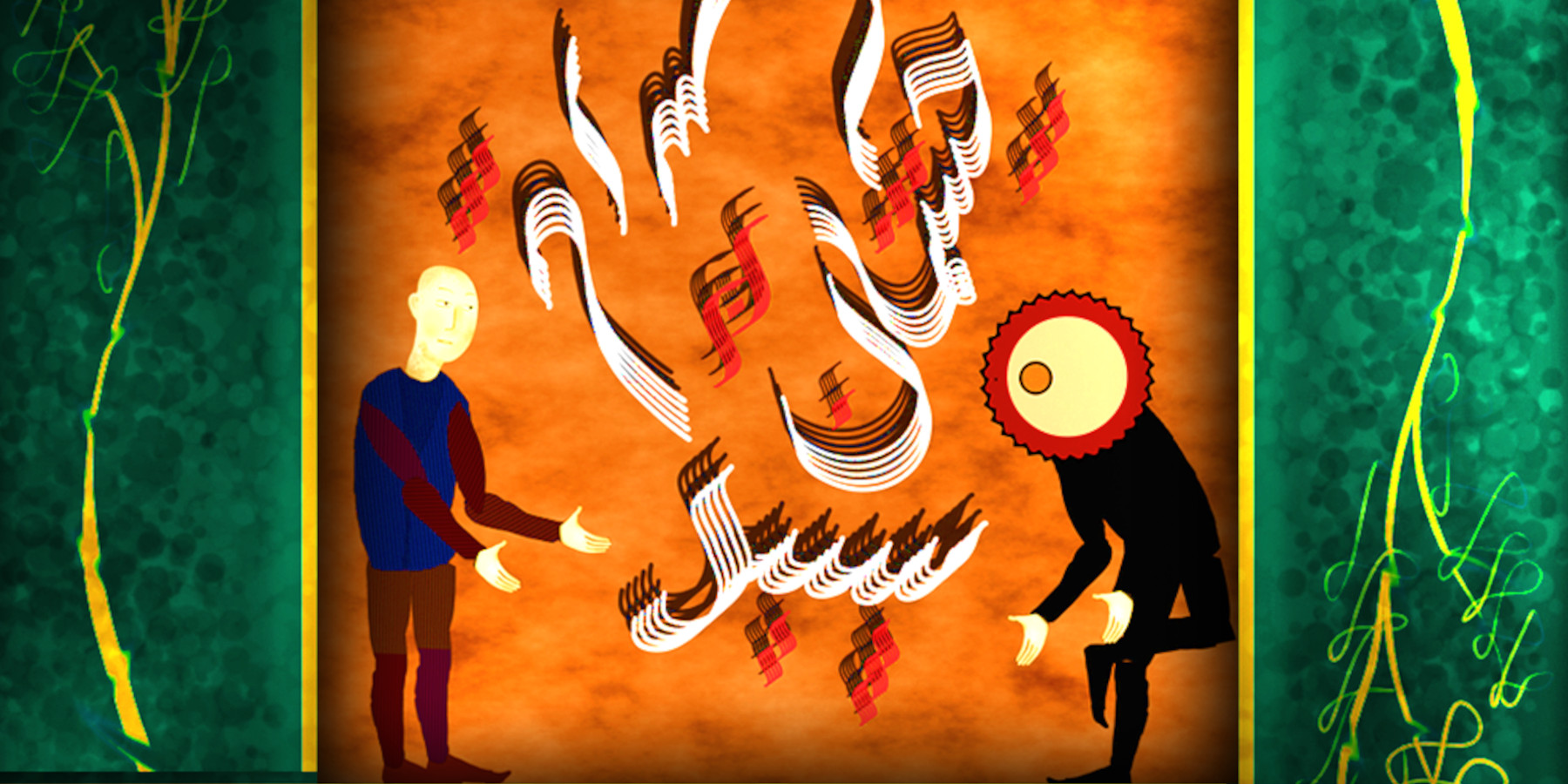
One of the best trends in the modern indie TTRPG space is people taking their personal local or cultural stories and ideas and turning them into beautifully immersive game experiences. Persia’s Paled Eyes is a fantastic example of this, as the game takes Persian mythology and Iranian children’s games and crafts them into a fascinating discussion about identity and what it means to be you.
At the start of Persia’s Paled Eyes, each player is given a playsheet. Then each player chooses one of the three houses (Avellyn, Myann, or Aggeryn) and marks it down on their sheet. Each house has a series of prompts (e.g., the first letter of your name), and the player will pick 10 to act as their facets during the game.
Turning Yourself Into Math

Once every player has done this, players privately answer the first 5 prompts they chose and discover how many points that answer is worth. In Persia’s Paled Eyes, each letter’s point value is the final digit of its place in the alphabet. For example, A is worth 1 point (as it is the first letter) while Z is 6 points (as it is the 26th letter; however, you only take the final digit, so it is worth 6 points).
After these five rounds, the first engulfment happens. At the start of this phase, the players take the results of their previous five rounds and find their median score. All the players then share this median, and one player works out the average of these medians. The resulting value is dubbed E.
During the main phase of the round, players split the numbers they scored in the previous round before adding them to form two separate values, one lower than E, and one higher than E. The difference between these two numbers is the player’s score for the round. Players with high values are eliminated (the exact number of eliminations per round depends on the number of players). After this, the game continues until one player is left.
However, players also have one other thing to worry about. In Persia’s Paled Eyes, whenever a player is handed an object by another player, they must say “recall.” If you fail to say recall when accepting an object, you are instantly out of the game. This adds a fun element of trickery to the game, as players try to spot moments where the other players are distracted enough to forget to hold up their end of the rule. Of course, this is a double-edged sword, as searching for these moments can often leave players so distracted that they forget to reply when they get given something.
A Game That Will Stay With You

Persia’s Paled Eyes is a beautiful game I thoroughly suggest checking out. While it can seem intimidating due to the sheer number of proper nouns and math that the game features. However, once you get over the initial hurdle and sit down to actually play it, it quickly becomes intuitive. In fact, after a quick practice round, most of the people I played with soon fell into the groove and could play like they had known the game for years.
I’m also a big fan of the game’s story section. Not only does the tale act as a framing device for the entire game, but it is also wonderfully told and is accompanied by some stunning art, making it worth picking up Persia’s Paled Eyes purely to enjoy it.
However, there are a few changes I would like to see in a hypothetical future update. While I appreciate the game’s compact size (doubly so because this feels like a game best played with physical copies), this limited size means many pages are text-dense.
While the writing is clear, the lack of paragraph breaks can make certain sections feel overwhelming. Plus, it makes it surprisingly easy to lose your place, something which can be quite frustrating during the mathematics-heavy sections, where you’ll be looking between the rules and your sheet frequently during your first few plays. So, breaking the text into smaller chunks with distinct gaps would dramatically help the game and make it much easier to learn.
In a similar vein, a flowchart that shows the basic game flow and the main thrust of each phase would also be a nice addition, as it would allow players to get a general feel of the game and how its elements link together at a glance.
Persia’s Paled Eyes is a great game that takes a specific mythology and shapes it into a fun but thought-provoking experience. While Persia’s Paled Eyes may not have heavy roleplaying elements like other TTRPGs, its focus on identity and converting that into usable numbers does often make it feel like you’re playing a TTRPG as yourself, giving the game a unique feeling that sets it apart from every other TTRPG I’ve played. Thus, I suggest giving it a try, as it shows how powerful and versatile the medium is!