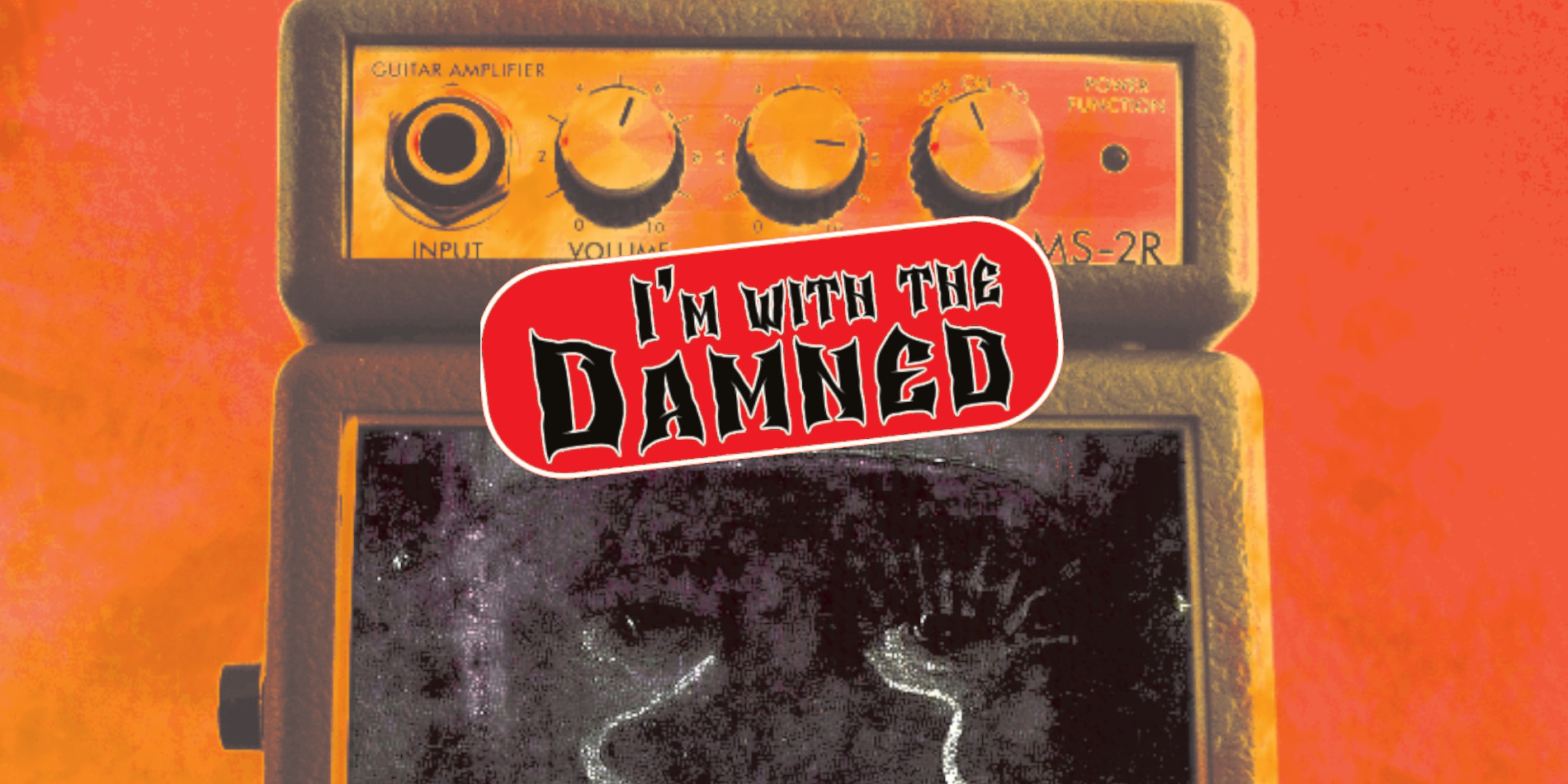
In 1983, Prefab Sprout declared that “The Devil Has All the Best Tunes,” and it’s hard to disagree with this statement. The idea of a musician selling their soul to the devil to gain inhuman talent has been a well-known myth for many years, and I’m with the Damned uses this myth to craft a memorable music-themed TTRPG that captures a band tasting the sweet and sour sides of fame.
I’m with the Damned is a tarot and music-based TTRPG suitable for play with or without a GM. The game casts players as members of an up-and-coming rock band with a dark secret; their success isn’t due to musical skill or years of practice. It’s because they made a deal with a dark entity.
Musicians On Their Last Tour

Before the game starts, the players take some time to answer some questions to create their characters, as well as the dark power they’ve made their infernal deal with. Players must decide what music they want to use for the game by either choosing a specific album or artist, or by creating a massive shared playlist.
When the game starts, the players have to grab their tarot deck and separate the Major and Minor arcana cards. Then they have to remove the Fool, Devil, Death, and the Tower from the Major arcana pile. After this, the Fool is placed in the center of the table, face-up. One of the other put aside cards is then chosen at random and placed face down on the other end of the table, forming a route of cards.
After this, the deck of Major Arcana cards gets shuffled, and two cards per player get placed face down between the already-placed Fool and mystery card. Finally, the Minor Arcana deck gets shuffled and distributed to each player.
Once the setup is complete, the main game flow begins. I’m with the Damned is broken up into scenes. Each scene commences with one player turning over one of the face-down cards in the route before consulting the prompt table to find out what that card represents. The player then uses this prompt to create a scene outline that explains where the characters are, what is going on, and who else is present.
After this, the players perform the scene. When the scene seems to be reaching its climax, a player can play one of the minor arcana from their hand to burst into song.
The player who played the card gets to decide what song is going to end the scene, with the specific card they played dictating what energy their character brings to the scene.
However, during this phase, another character may attempt to steal the spotlight by playing a minor arcana of their own. This action triggers a bidding war where both players aim to play the highest-value card or get another player to play a high-value card to support their bid. If the second player ends up with the higher-value card, they get to take over the musical number and pick the song. However, if they fail, the original player maintains control of the number, and their chosen song will be the one used.
Once the song is selected, the players decide if the music is diegetic or non-diegetic within the scene they’re playing. Then, as everyone listens to the song, the players describe what the montage looks like and what their characters are doing during it.
This process then repeats until only the final card in the route remains. When only this card is left, the final scene begins. One player turns over the card and consults the prompt table to find how the band’s story ends.
More Than A Sum Of Its Parts

I’m with the Damned is a fantastic game. While the game’s structure is simple, during play it becomes way more than the sum of its parts. A big reason for this is the prompts, all of which do a great job of evoking the feel of classic rock band touring dramas without ever forcing the players to go in a specific direction.
Plus, the game’s use of music is sublime. While the idea of everyone listening to a song together may sound like a gimmick on paper, during play, it leads to some of the most transcendently memorable role-playing experiences I’ve ever had. Not only does having everyone listen to actual music enhance the game’s rockstar theme, but the music also dramatically adds to the scenes, making everything feel much more emotional and impactful.
I’m also a fan of the game’s spotlight-stealing system. Having the players fight over who gets to choose the scene’s final song helps capture the simmering tension that defines big-name rock bands on the verge of breaking up. However, by limiting this competitive element to the end of scenes, I’m with the Damned sidesteps a common issue that ruins similar games. In many games with spotlight-stealing mechanics, scenes often grind to a halt as players repeatedly try to wrestle control from each other. In turn, this can also end up overshadowing the scene, as players are so focused on finding the next moment to seize the spotlight that they ignore the actual ongoing scene. However, this isn’t the case in I’m with the Damned as players only get the chance to steal right at the end of the scene, allowing them to give the main bulk of the scene their complete focus.
I also love I’m with the Damned’s play guide. At the back of the book, there is a page giving tips on facilitating the game, GM’ing the game, teaching others to play the game, and handling content and safety. These are all fantastically well-written and do a great job of breaking the game down for those new to facilitating or teaching games. However, by having it at the back, I’m with the Damned strikes a nice balance, making the information accessible to everyone who wants it, while guaranteeing that newcomers don’t get overwhelmed by several pages of meta discussion the first time they open the game.
I’m with the Damned is one of those games that’s hard to do justice in review form. While reading the game, you’ll quickly realize that it’s something special, but it’s not until you play it that its true brilliance gets revealed. During play, the game pushes players towards great role-play in a way that feels natural and effortless, meaning that every game of I’m with the Damned is sure to stick in your memory long after your band breaks up.