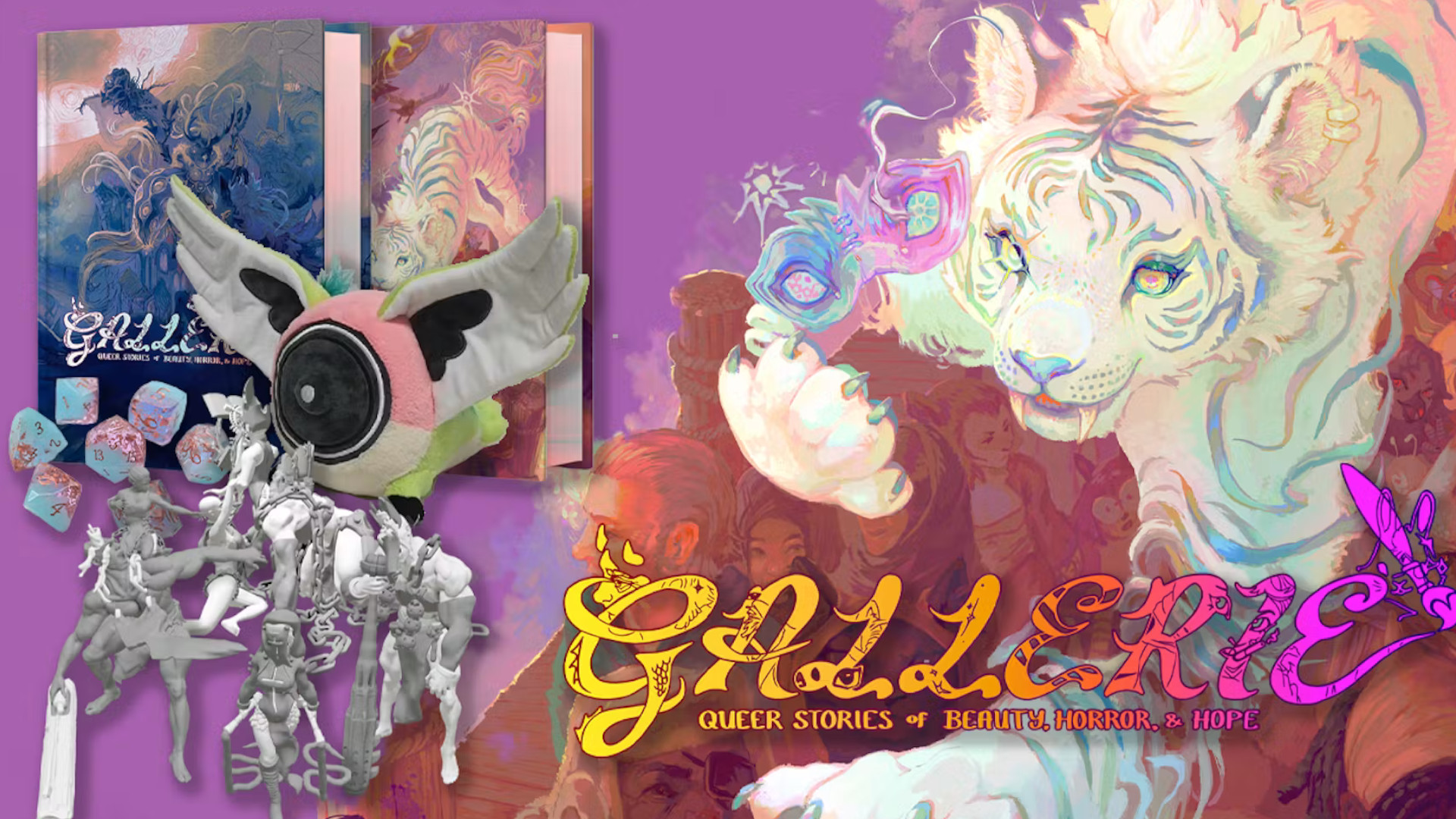
What does it mean to be your true self? The process of becoming who you feel you are is often a hard one, as it frequently requires you to push back against the world and stand firm against those who would prefer you stay how you are. Gallerie, a new TTRPG currently crowdfunding on Backerkit, transplants this journey into a magical world overflowing with magic and uses it to create an epic adventure where the true treasure is liking the person you see in the mirror.
Disclaimer: This review is based on a playtest version of the game. Things may change between this version and publication.
Making A Many-Layered Person

Gallerie is a group TTRPG that casts players as people who have found themselves in a strange situation. A life event has caused them to fall out of our world and land in a magical world called Gallerie. In this world, powerful beings named Patrons create and shape worlds like a painter creating a work of art on a canvas, meaning that every inch of this world is both strange and familiar. Thankfully, while in this world, the player becomes a muse, a being composed of the world’s unused and misplaced magic, granting access to both powerful abilities and the power to shape their form however they wish.
One thing that sets Gallerie apart from similar games is its unique approach to characters. For example, the game has three main stats: Mind, Body, and Community. However, each stat has two traits: the Exert Score (used when physically doing something with that stat) and a Perception score (covering noticing things with that stat).
On top of this, each stat has linked Proficiencies that show how good the character is at specific tasks related to that stat (e.g., Body has athletics, and Community has culture).
These numbers are used as part of the game’s simple checks system. Whenever a character wants to try to do something with an element of risk, they roll two ten-sided dice and add the relevant stat (in either its Exert or Perception variant), and any relevant Proficiencies. If the result is over 16, the action is successful. If the total is under 16, the action fails or goes wrong. However, certain abilities allow you to influence your rolls (by either changing the size of the die used or adding a modifier), giving the game a good amount of strategy.
On top of this, Gallerie has an interesting system for character creation and evolution (befitting the game’s focus on self-actualization). Character creation is split into two phases: Initial Creation (before the game starts) and Manifestation (which occurs as you play).
The Initial Creation phase is treated like a conversation. The player decides who their character was before they fell into this new world (covering details such as name and age). On top of this, the player has to pick an animal-themed motif that they think best resonates with their character, which will give them a specific collection of starting stats and abilities.
Player characters also start with Leits (a sound, feeling, or thing that connects or embodies your character’s internal narrative and embodies you at your best), and Affinities and Disdains (representing the environments and events the character thrives in or is stifled by).
Interestingly, while you can choose these (as you would in other TTRPG games), Gallerie encourages players to randomize this process as the game is less about your starting point and more about the process of finding and shaping yourself as you progress.
This plays into Gallerie’s concept of Manifestation, which starts when your character levels up for the first time. At this time, you’ll select a specific Manifestation path (linked to your motif), receive an instrument or piece of equipment, and learn a special ability called a stoke. As your character continues to level up, they’ll get various special abilities from their Manifestation path and slowly develop themselves into a form that feels comfortable for them. For example, those who follow the Kisshit path get the ability to ride in someone’s shadow. However, people who opt to chase the Rayu line gain the ability to summon storms on command. Meaning that each character feels different and has unique options during play.
A World Where Chasing Yourself Is The Best Option

Gallerie is a fascinating TTRPG. The game’s setting really is the star here, as the game’s text does a fabulous job of pulling you into this unique, often-symbolic world. The game strikes a nice balance, as while the pre-made locations, people, and creatures are evocative and really capture the idea of a world where the creators build things that follow their whims with no consideration to rhyme or reason, the game maintains a solid core, making the game feel cohesive and giving GMs a good idea of the type of things they can do and creatures they can introduce while running the game.
The game also does a wonderful job of handling queer topics. The game’s focus on living with a physical form that doesn’t feel true to yourself, and the long, rocky road to becoming comfortable in your form and reaching self-actualization, will totally resonate with queer players and lead to some very emotional scenes at queer-led tables. However, the game also shows admirable amounts of restraint, as it’s never in-your-face about these themes, instead opting to use the setting and mechanics to gently guide players towards these topics and lines of thought, which makes the overall experience hit harder.
The game is no slouch mechanically either. While the idea of having two versions of each stat may feel a little strange at first, it works really well in practice and gives players more space to create unique, interesting characters with nuanced skill sets and different ways of approaching problems. I’m also a big fan of the various Manifestation options. Not only are there plenty of options that allow players to customize their characters however they wish, but the designers have worked to guarantee they all feel unique and can be used multiple ways. This means that players can approach every situation in numerous ways, leading to plenty of unique and memorable moments.
Plus, the game has quite a few mechanics, allowing players to interact with the world in numerous fun ways, which means Gallerie can be used to tell many fascinating stories, from the classic TTRPG standards to more experimental fare, meaning that this game could easily become a regular title in your group’s rotation.
Finally, the game looks beautiful. While the preview (obviously) lacks a few major pieces of art, what is here is stunning. Plus, all the art captures the tone and feel of the game’s text, so they complement and enhance each other, making it very easy for GMs and players to immerse themselves in the world of Gallerie.
However, there are some elements I would like to see tightened in future updates. Firstly, while I adore the game’s visual style, certain blocks of text (especially those on pages with coloured backgrounds) can be a little hard to read.
Plus, as it stands, the game would be massively enhanced by a rules flowchart or a cheat sheet. While the game’s flowing style of explanation and occasional turns into extended in-universe fiction are evocative and suit the game’s dream-like setting, it does sometimes make it hard to find what you need in the heat of the moment. So a paired-back page or stand-alone sheet would be a great addition in later updates and make the game much more accessible to players who struggle with memorizing rules.
I’ll also admit to being a little disappointed the game doesn’t have a fail-forward mechanic. While I appreciate how simple the checks are, in my eyes, a big part of the self-actualization process is trying something and failing, only to learn something important from the failure itself or the resulting fallout. So the fact that failures are played straight in Gallerie (or there is no way to get what you want with a caveat) does feel like a missed thematic opportunity.
Gallerie is a TTRPG that has a lot of promise. It is clear from the first page that the game’s blurb about finding yourself isn’t just marketing speak, that the designer has put a lot of thought into the idea and actively worked to ensure each mechanic (as well as the game’s general structure) evokes and ties directly into the theme. So, while the game isn’t totally finished yet, Gallerie totally should be on your radar if you’re a fan of magical worlds and emotion-driven TTRPGs.