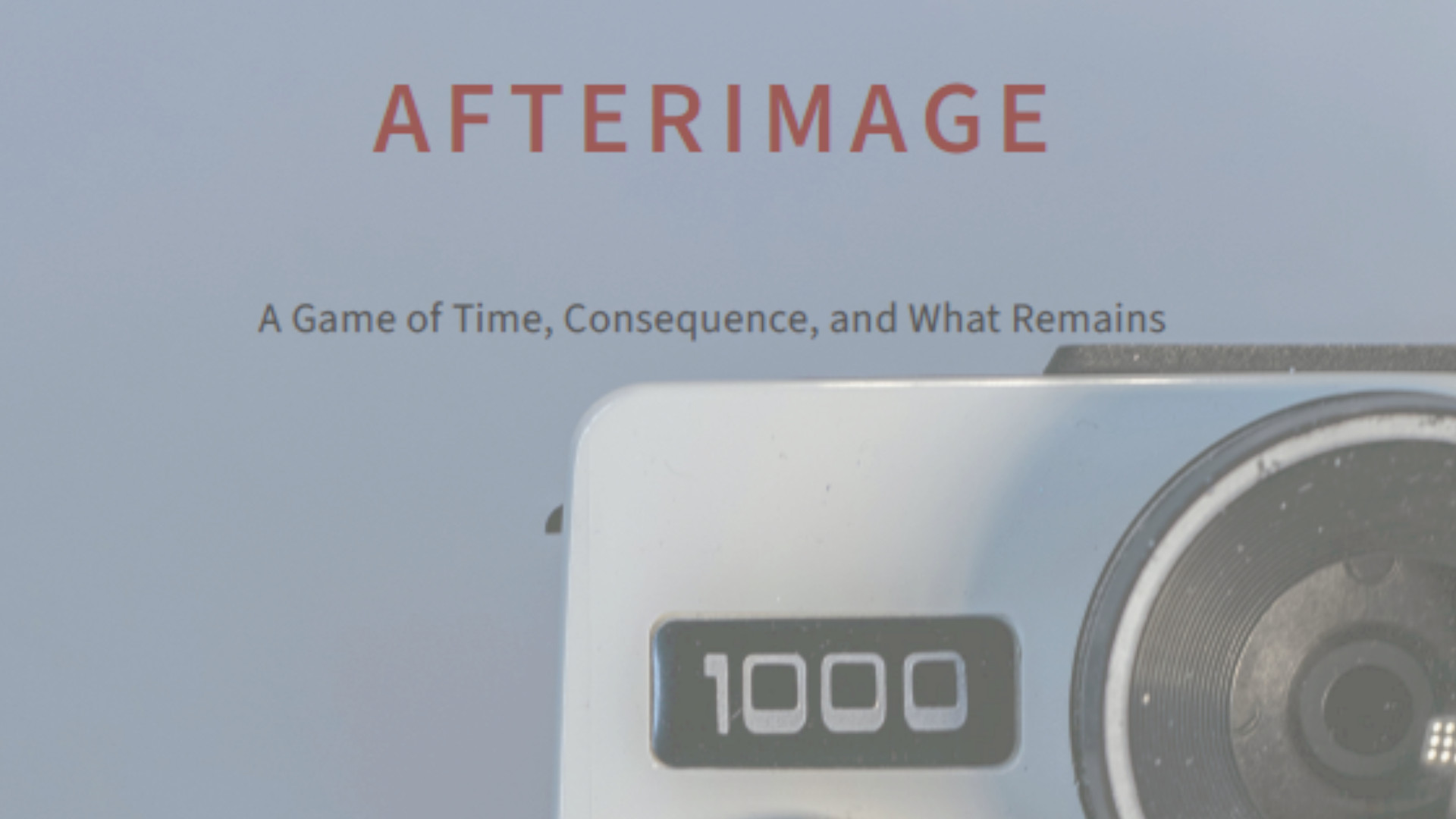
If you could rewind time, what would you use it for? Most people will jump to the thought of using the power to undo a previous bad decision they regret. However, the longer you think about it, the more difficult the decision becomes, as you’re left wondering what knock-on effects changing that decision could have. Sure, you would be happier, but would it lead to a better world or a worse one? Afterimage is a TTRPG that taps into this, putting you in a Life Is Strange-style situation where you can undo your mistakes, but risk making things worse by doing so.
Afterimage: A Game of Time, Consequences, and What Remains is a TTTRPG created by Loreseed Workshop that can be played either solo or as a group (with slightly different rules depending on which you choose, though the core experience remains mostly the same). To play, you’ll need a deck of playing cards, index cards (for keeping notes), several six-sided dice, and various counters.
Navigate The World And The Timestream

In the game, you play as a young person who lives in a small town. As is the norm for fictional small towns, this place isn’t what it seems on the surface, and numerous long-buried secrets are sitting just below the surface, waiting to be discovered (even if their discovery will reopen old wounds and cause untold chaos)
The game has two types of characters. One player is The Lens. They have a special power: they can rewind time and jump between timelines. While this allows them to change their fate and alter situations, they also retain memories of these alternative outcomes and timelines, which means they carry a lot of sadness in their hearts.
The other category of characters is Anchors. They are everyone else in the Lens’ life and the people who motivate them to go forward. Unlike the Lens, they lack powers and only remember their current timeline.
Before the main story begins, the player (or players) will create 5 specific Anchors who are crucial to the main character’s journey, giving them names and describing how the main character knows them. These relationships are graded on a 5-point scale that ranges from positive (such as trust, respect, or admiration) to negative (such as doubt, envy, or resentment). Should the relationship ever hit one end of this scale, a big moment (one that redefines the relationship) happens.
Each of the game’s scenes follows a similar structure. The player will pick which of the previously named Anchors will be the scene’s focus (or draw a card to get a random one). The player then draws a card to discover the general theme of the scene and then plays it out, rolling when things are uncertain and continuing until either something changes (like the relationship or the overall situation) or a question is answered.
Once this has happened, the player notes down any changes to the relationship. They also check if any Spades were drawn during the game. Whenever a Spade is drawn, the player gains a fragment, a prompt that will help them think about the wider story of both their character and their town’s mystery, both of which will be used to decide how the game ends.
Thankfully, you do have a way to turn the tide against fate: your Lens’ special powers. The first is Rewind, which (as the name likely suggests) lets you rewind the scene a few seconds, allowing you to undo a choice or take back a word you’ve quickly come to regret. However, be careful: if you rewind after one of your relationships has hit either end of the axis during that scene, it becomes locked in and can’t be changed. So, a badly timed rewind can destroy one of your relationships, no matter how much you want to save it.
The other power is Leap. This allows you to jump backwards in time, letting you undo massive moments. At any point during play, you may make a snapshot by writing the current situation on an index card. These snapshots represent the moments you can jump back to. However, you can only have 4 snapshots at once. Thus, you must carefully choose the moments you snapshot and use them cautiously, as once a snapshot is used, it is gone forever, meaning you can’t retry the same moment over and over.
But you can’t use these powers whenever you feel like it. Because whenever you use them, you gain Static, which the game neatly sums up as “wrongness that accumulates.” If your Static ever reaches a threshold value (which is set at the start of the game based on how long you want your game session to be), the game transitions to a final scene where you try to put the pieces together and decide what happens to your character, meaning that you have to make each use of your powers count.
Making Fleeting Moments Count

Afterimage is a fantastic TTPRG that does a good job of capturing the tone and atmosphere of coming-of-age dramas like Life Is Strange and translating it into a fun TTRPG. While the game may seem complex at first glance, the mechanics come together to form something really special.
I’m a big fan of the fragment system, as it helps give the story a natural flow and a great sense of escalation, because you never go extended periods without receiving a new plot beat. However, there is enough time between them to give you space to ponder what is going on, flesh out your world, and really consider both your character’s emotions and their place in the setting.
I’m also a massive fan of the relationship axis system. It does a great job of capturing the natural messiness of relationships, with relationships often going from great to negative in the blink of an eye. It also captures how relationships can’t be optimized; sometimes doing the right thing will mean hurting a relationship you otherwise treasure, even if you don’t want to. Meaning this game gets surprisingly emotional in its later scenes as you try to juggle your relationships with the quickly progressing mystery.
The powers are also a great mechanic. The idea of being able to rewind and jump back in time may sound like it would undo any tension and make the game easy to beat. However, the powers are designed to make the game tenser and create heartbreaking moments. For example, having to pre-decide the moments you can return to often leads to situations where you’re unable to undo a mistake because you don’t have a suitable snapshot, or you had to give up the perfect snapshot to make another one that you need for something else. Plus, the Static system is well balanced. This means that, while you can’t use your powers at random, you can use them frequently during scenes, which really fits the story the game is trying to tell, as it lets you explore all the different options available to you.
Thankfully, for players who find the game’s numerous mechanics overwhelming, Afterimage offers an alternative ruleset called “Focused Mode.” This mode removes some of the game’s variables and has you make fewer Anchors, reducing the number of things you need to keep track of during the game. If you’re new to solo games, this is the mode I suggest you start with, as it lets you play a quick story to get a feel for the game before diving into the complete ruleset.
My only main issue with Afterimage is the book’s structure. If you read the book in order, you’re presented with a lot of mechanics and proper nouns in quick succession. While these mechanics are easy to understand individually, it is often hard to understand how they fit into the game as a whole and how one thing leads to another. However, near the end of the main rules, there is a page that gives an overview of the game’s general flow. If this page were moved to the start of the book, it would make the game much easier to follow, as you would be able to understand how each rule fits into the game’s flow.
Afterimage is a great game for players who love teen drama and small-town mystery. The game will quickly pull you in, and you’ll find yourself deeply caring about the characters you create and deeply immersed in the unfolding mystery. Thankfully, the game’s mechanics feature plenty of variety, so you’ll be able to play Afterimage numerous times without ever getting the same story twice.