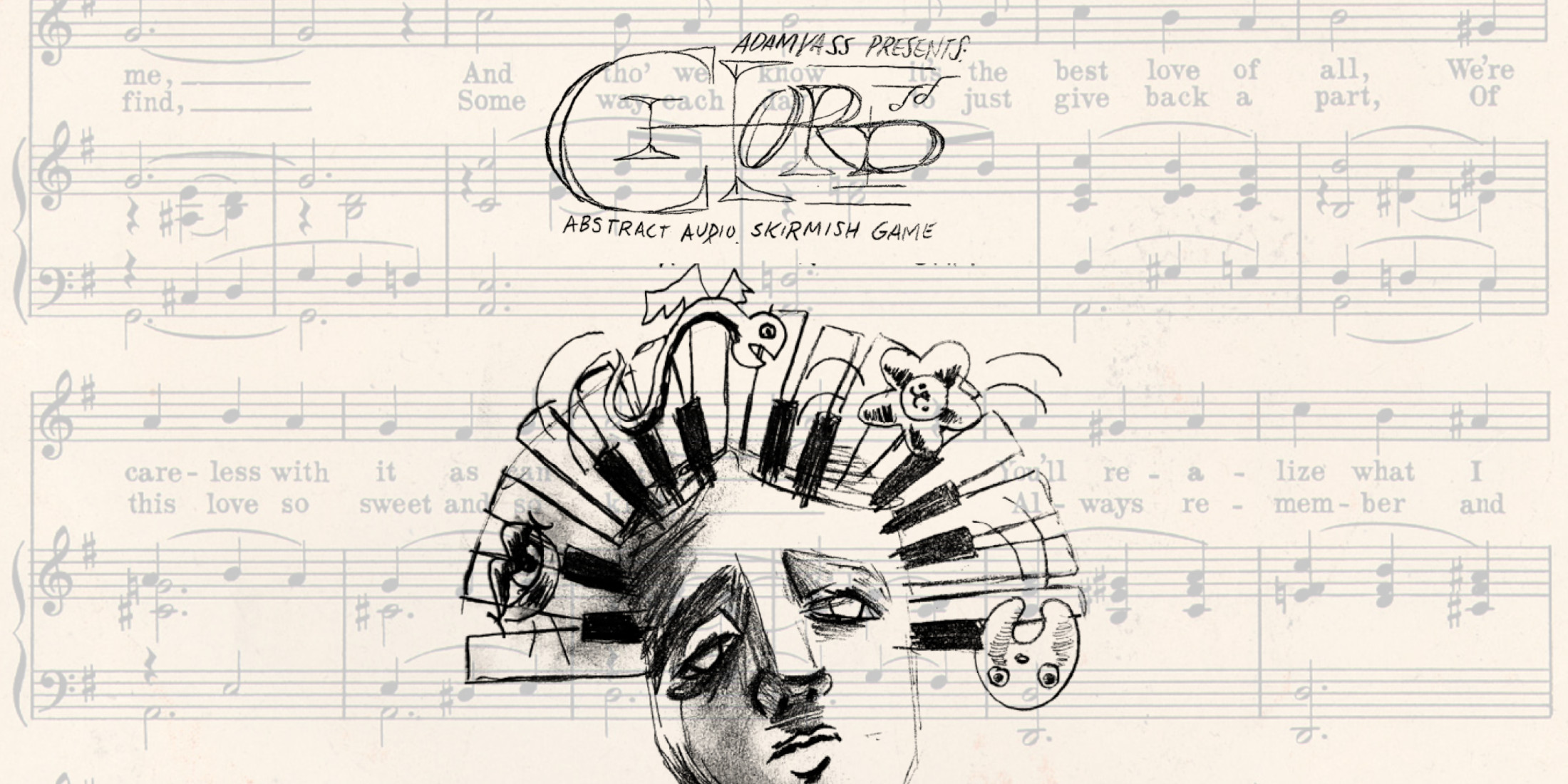
I’m always a fan of TTRPGs and board games that go beyond tabletops and dice. The biggest strengths of analog games as a medium are their open nature and the fact that they are not restrained by technology, meaning that designers are free to create games about anything and use any object or prop the creator can think of. Chord is a great example of this, as rather than a traditional table, this miniature tactics game asks players to play it on a piano or keyboard, leading to a memorable experience that is quite unlike anything else I’ve ever played.
At the start of Chord, both players gather three minis to act as their sprites (with the game suggesting using things about the size of nickels). Each player also needs a mini to act as their flag and some tokens to keep track of the various things that happen during the game.
A Battle Across Two Octaves

Each sprite starts the game with four stats: Speed, Range, and Energy. Speed controls how far the sprite can move, Range shows how far a sprite can interact, and Energy covers how many times a sprite can get hurt. Each of these stats has a default starting value, but before the game starts, the player may distribute an extra five Speed points across their various sprites.
Plus, each sprite also gets a special ability, but in a unique twist, no two sprites on your team can have the same ability, meaning that you can’t find a single good combo and spam it.
At the start of the game, each player puts their flag on the key that is one octave away from Middle C. Each player then puts their sprites down in whatever order they wish. The first sprite is placed on the same key as the flag, and then the other two are placed on the adjoining two keys.
After this, the game begins. At the start of each player’s turn, they play the notes their sprites are currently residing on (either as a full chord or as single notes). The player then chooses one of their sprites.
That sprite can then perform three actions in any order. That sprite can move keys equal to their Speed stat. They may also “Mess Up” any opposing sprite that is within the sprite’s Range. When the player opts to do this, both players play Rock, Paper, Scissors, until a player wins, with the losing sprite losing one of their energy points. Finally, if the sprite is within two keys of the other player’s flag, the sprite can grab it.
As you likely expect, the game follows traditional capture-the-flag rules. Players must grab their opponent’s flag and return it to their own flag space. If a sprite runs out of Energy while carrying the flag, the flag is dropped, and the sprite is forced to return to the player’s flag space. A dropped flag can be grabbed by another sprite (who can continue carrying it) or grabbed by the flag’s team (which returns it to its starting position).
Whimsical But (Musically) Rich

Chord is a fascinating game that often feels like a 2D version of chess. Due to friendly pieces not being able to share the same space, and the limited actions you have per turn, thinking two to three moves ahead is essential if you want your sprites to come out on top. Meaning that, despite its whimsical theme, Chord has a surprising amount of strategy underpinning it, meaning games can actually get quite intense when you get into it.
I’m also a fan of the music element. Having the players play the notes, their sprites start the turn on (or the ones they end up on when they move), may sound like a gimmick. However, this element helps give the game a unique atmosphere, with the notes (however atonal they may be) creating a constantly evolving soundtrack.
In fact, one of the highlights of my playtests has been seeing how players quickly start using the notes as both elevated trash talk and as a way to psych out the other player. For example, when closing in on the enemy flag, I took great joy in playing my three notes in a way that evoked the iconic theme to Jaws, or playing notes differently to give each of my sprites unique personalities (with slow sprites getting long sustained notes and faster ones getting rapid staccato notes). Because of this, Chord often feels like a role-playing game with music instead of words.
I’m a massive fan of Chord’s art style as well. All of the art has a scruffy, hand-drawn look that is really pleasing to the eye and does a fantastic job of capturing the game’s chaotic feel. I also love the numerous weird and wacky sprites that litter the pages, as not only are they delightfully adorable, but they also do a great job of informing readers of the Chord’s tone, which really helps when introducing new players to the game.
Chord is a fascinating game. The blend of music and tactics is very unique and comes together surprisingly well, creating an experience that is quite unlike any other game currently on the market. Because of this, if you are an analog game fan with access to a piano or keyboard, then you have to make time to play Chord, as it will have you looking at your keys in a whole new way.